
Electric Fireplace Repair
Heater, blower, remote, or flame-effect acting up? One tech sorts it out.
Learn moreAdding or upgrading a gas burner pan and log set is more than dropping in logs — it's a code-compliant install that ties together the gas line connection, valve, and igniter, with a millivolt or remote control if you want one. Having one crew run the gas work and the appliance fitting together means it's pressure-tested and dialed in as a single safe system, in one visit, instead of splitting it between a gas plumber and a fireplace shop.
The burner is the heart of a gas hearth, and it is the one component where a wrong choice can't be tuned away later. Texas Service Experts installs the burner system as a sized, fuel-matched assembly: a burner pan or tube rated in BTU to the volume of your firebox, fed through the correct orifice for your gas, and laid out beneath a ceramic log set whose every piece sits on the manufacturer's placement diagram. Get those three right and the fire is tall, even, and clean for the life of the set; get any one wrong and no amount of adjustment fixes it. We treat the burner the way the engineering deserves — and because the crew is already the one handling your flue and venting, the burner work slots into a single visit instead of a standalone trip.
Sizing comes first, and it's unforgiving. A burner rated above the firebox it sits in throws flame against the back and sides, scorching the panels and soot-blacking the logs; one rated below it looks thin and starved. We measure the firebox depth, width, and height and match the burner's BTU input to it — not to the biggest set on the shelf. How this differs from vented gas logs installation: that service is chosen for the look of the flame and turns on whether your chimney can carry the exhaust, while this one turns on whether the burner hardware is correctly sized and built for your firebox and fuel, chimney or not.
Fuel is the second hard fact, and it's where most botched installs hide. Natural gas and liquid propane aren't interchangeable: LP runs at roughly three times the manifold pressure and needs a far smaller orifice to meter it, so an NG burner fired on propane over-gasses, sooting and roaring, while an LP burner on natural gas starves to a weak blue flame. We confirm your fuel at the meter or tank, fit or drill the burner to the correct orifice for it, and set the air shutter to match — the conversion is a parts change, not a knob turn, and we never guess it.
Then comes the layout, which is the craftsmanship the homeowner actually sees. We bed the burner properly — vermiculite or silica sand under a pan burner to diffuse the gas across the whole pan — and set each ceramic log exactly to the manufacturer's diagram. Log placement is the whole game: a single log a half-inch out of position makes the flame impinge on it, and an impinging flame quenches, soots, and streaks the firebox black within a season. We dress the set with the right ember and glowing-coal media so the bed glows like a real coal fire, not a row of lit pipes.
Last comes commissioning the burner as hardware. We confirm flame travels the full burner length and lifts off every port evenly, check that no flame strikes a log, verify the air shutter gives a crisp flame with no soot tip, and run an ambient CO check while it burns. We tie into whatever valve and ignition you already have so the set lights reliably, but we don't sell those here — a failing valve or a new ignition or remote is its own job. What this visit hands you is a correctly built fire: sized, fueled, and laid out right.
Buy two identical log sets and the boxes are the same; what makes one a showroom flame and the other a sooty disappointment is entirely the sizing, the orifice, and the placement behind it. That's the part you can't buy off a shelf, and it's exactly the part we don't shortcut.
With our crew, a gas burner installation is never guesswork. We scope every job from a graded, photographed inspection first — the NFPA 211 level the evidence calls for — so the work is matched to what your flue and masonry actually need, with the report to prove it. The documented inspection is the record the gas burner installation is built on.
Chimney inspectionA gas burner installation isn't a matter of opinion — it's held to published national standards. Texas Service builds every job to the named codes below and documents it, so the work is provably right for an inspector, an insurer, or a future buyer. These are the universal standards; your city's permit and inspection requirements are confirmed with the local authority before we pull the job.
The burner's BTU input rating is matched to the appliance and its gas supply, as the NFPA 54 National Fuel Gas Code requires; we never install an over-fired burner just to fill a larger opening, because over-firing overheats the firebox.
Natural gas and LP take different orifice sizes and manifold pressures, so the burner is fitted with the orifice listed for the fuel actually feeding it; run the wrong orifice and the unit burns sooty or starved.
Setting each ceramic log to the manufacturer's placement diagram keeps the flame from impinging on any log, and impingement is the direct cause of sooting and carbon build-up.
Light-off is followed by an ambient CO check that has to show clean combustion across the burner's full length before the set gets signed off.
Codes cited are the established national standards (NFPA, UL, IRC) that govern this service. The adopted code edition, permit, and inspection requirements vary by city —Texas Service verifies them with your local authority having jurisdiction on every job.
Match burner BTU input to the firebox volume.
Set the correct NG or LP orifice and air shutter.
Bed the burner and place each log to the diagram.
Confirm even flame, no impingement, CO-clean.
We've worked on 1,000+ DFW homes over 10+ years. Every job — small sweep or full rebuild — runs the same way: certified technicians, written quotes, photo reports, warranty in writing.
Burner BTU sized to your actual firebox
Correct NG or LP orifice — fuel-matched, never guessed
Logs laid to the maker's diagram for a clean flame
Burner commissioned with a live CO check
Family-owned, CSIA-certified, NFPA 211–compliant. We're the team you call when you want it done right the first time — no rotating subcontractors, no upsell pressure, no surprises. Same techs, same trucks, same standard.
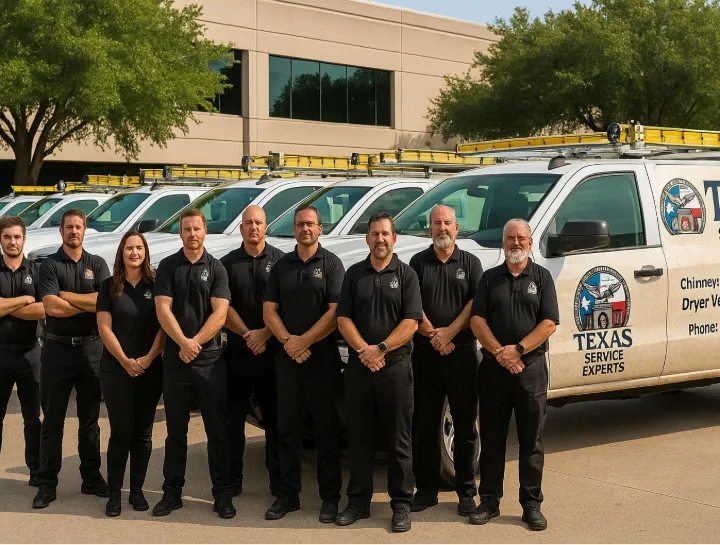
The NFPA recommends a Level 1 inspection every year, with a sweep once buildup reaches 1/8" of creosote — for a wood fireplace you actually use, that's about once a heating season. The neighborly part: since we're already on the roof, the same crew checks your dryer vent and caps the visit with a quick whole-home safety look, so one appointment covers what would otherwise be three.
Yes — our inspectors hold current CSIA (Chimney Safety Institute of America) certifications, verifiable in the CSIA member directory at csia.org, and we have NFI specialists for fireplace work. The same trained crew handles your chimney, fireplace, dryer-vent and air-duct needs, so you're not juggling four different contractors for one house.
Yes — 24/7 response (subject to crew availability) for active leaks, an animal trapped in the flue, post-fire damage, and storm damage, same-day in most cases. One call reaches one crew that can handle whatever the situation turns out to need, instead of bouncing you between specialists while the water's still coming in.
Always — a written quote before we lift a tool, with photos of what we found, so you see exactly what you're approving. If the same visit turns up something in the dryer vent or ducts, it goes on one itemized quote and one invoice rather than a string of separate trips.
The Whole-Home Care Plan is our annual maintenance plan at $19.99/month ($240/year): a Level 1 inspection and sweep ($248 value), priority scheduling, 10% off all repairs, and emergency-response priority. Because one crew covers chimney, fireplace, dryer-vent and ducts, the plan keeps the whole house on a single schedule instead of a calendar full of separate service calls. Cancel anytime, no contract.
Last reviewed:
Other services in the Gas & Fireplace category.
Free written quote. Same-week scheduling. 24/7 emergency response when you need it.
Active leak, animal in flue, post-fire damage, or smoke event? Real humans on the line 7 AM to 12 AM every day — replies in under 2 minutes. Tech dispatch within 2 hours during business hours, subject to crew availability after-hours.
Emergency line