
Chimney Waterproofing
Breathable whole-stack sealing that sheds rain while letting the masonry dry.
Learn moreThose rust streaks down the side of a factory-built chimney almost always start at a cheap galvanized chase cover that pools water instead of shedding it. We custom-fabricate a stainless or copper replacement, measured and formed to your chase with the slope, overhang, and sealed collar openings that actually drain. It's the modest fix that heads off thousands in hidden firebox and framing damage — and while we're up there forming it, the same crew can settle the cap and any flashing in the same trip.
If your chimney is a framed chase — the boxed-in structure common on factory-built, prefabricated fireplaces — it doesn't have a masonry crown. It has a chase cover: the metal top pan that caps the chase and sheds water around the flue collars. On most prefab homes that pan was builder-grade galvanized steel, and galvanized rusts. A rusted chase cover is one of the most common and most preventable sources of prefab-chimney water damage, because once it rusts through, it funnels water straight down the chase onto the firebox, the framing, and the ceiling below — and the rust streaks running down your siding announce the problem long before the leak does.
Texas Service Experts replaces failed chase covers with watershed-grade stainless or copper, fabricated to fit your chase rather than approximated from a stock pan. The detailing is where a careful replacement separates itself: we form the cover with a proper slope and, where the chase is wide or the original ponded water, we weld in a cricket or water-diverter so runoff sheds away from the flue collars instead of pooling around them. The collar openings are sized and sealed correctly so the very penetrations that protect the flue don't become the next leak. Stainless will outlast the home's original galvanized by decades; copper adds longevity and a finished appearance on a visible chase. Either way, we are building a top that drains, not one that holds water until it rusts again.
Metal alone doesn't make a cover work — the fit does. Measured wrong or fabricated to a generic footprint, a chase cover leaves gaps at the edges or sits flat where it should slope, and either defect simply reopens the leak the new cover was meant to stop. So we measure your chase precisely, fabricate to that measurement, and set the cover with the overhang and fastening that keep wind-driven rain out at the perimeter, not just at the collars. On a tall or exposed chase we plan for uplift, because a cover that lifts in wind admits water and eventually tears loose. None of that shows in a photo of a finished chase — it shows in a firebox that's still dry years later.
A chase cover is a perfect small example of whole-home thinking: a relatively modest replacement that, done right, prevents thousands of dollars of concealed water damage to the firebox and framing. We tell you honestly whether the cover alone is the problem or whether water has already reached the structure beneath — and if it has, the same crew traces and fixes the framing and finish too rather than capping a problem left active underneath. Replace the pan with the right metal, detailed to shed water, and the leak that was inevitable simply never happens — handled, like the rest of the chase, by one team in one visit.
With our crew, a chase cover replacement is never guesswork. We scope every job from a graded, photographed inspection first — the NFPA 211 level the evidence calls for — so the work is matched to what your flue and masonry actually need, with the report to prove it. The documented inspection is the record the chase cover replacement is built on.
Chimney inspectionA chase cover replacement isn't a matter of opinion — it's held to published national standards. Texas Service builds every job to the named codes below and documents it, so the work is provably right for an inspector, an insurer, or a future buyer. These are the universal standards; your city's permit and inspection requirements are confirmed with the local authority before we pull the job.
Think of the chase cover as the prefab version of a masonry crown: we form it with a slope so water drains rather than ponds, replacing the flat pan whose standing water caused the failure in the first place.
An overhang runs the full perimeter of the cover and the flue-collar openings are sized and sealed correctly, so the next leak cannot start at the edges or the penetrations.
Where the chase is wide or has a history of ponding, we weld in a cricket or diverter to steer runoff around the flue collars, borrowing the same water-management logic the IRC applies to a roof cricket behind a chimney.
Each collar opening holds the manufacturer's required clearance around the factory-built (Class A) flue pipe, and the cover never closes the air gap the listing demands.
Codes cited are the established national standards (NFPA, UL, IRC) that govern this service. The adopted code edition, permit, and inspection requirements vary by city —Texas Service verifies them with your local authority having jurisdiction on every job.
Precise measurement of the chase and flue-collar layout.
We form a stainless or copper cover to fit, with the slope and overhang it needs.
We fasten it correctly and seal the collar openings watertight.
We confirm the runoff sheds clear and check for any damage hiding underneath.
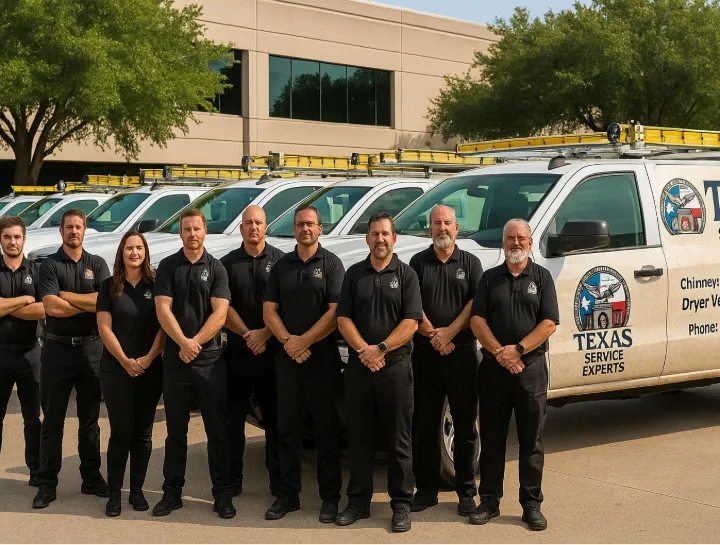
We've worked on 1,000+ DFW homes over 10+ years. Every job — small sweep or full rebuild — runs the same way: certified technicians, written quotes, photo reports, warranty in writing.
Custom-fabricated to fit your exact chase, so you're not stuck with a leaky stock pan
Stainless or copper that outlasts galvanized by decades
Built with real slope and a welded cricket or diverter so it drains instead of ponding
Flue-collar openings sized and sealed correctly
Family-owned, CSIA-certified, NFPA 211–compliant. We're the team you call when you want it done right the first time — no rotating subcontractors, no upsell pressure, no surprises. Same techs, same trucks, same standard.
The NFPA recommends a Level 1 inspection every year, with a sweep once buildup reaches 1/8" of creosote — for a wood fireplace you actually use, that's about once a heating season. The neighborly part: since we're already on the roof, the same crew checks your dryer vent and caps the visit with a quick whole-home safety look, so one appointment covers what would otherwise be three.
Yes — our inspectors hold current CSIA (Chimney Safety Institute of America) certifications, verifiable in the CSIA member directory at csia.org, and we have NFI specialists for fireplace work. The same trained crew handles your chimney, fireplace, dryer-vent and air-duct needs, so you're not juggling four different contractors for one house.
Yes — 24/7 response (subject to crew availability) for active leaks, an animal trapped in the flue, post-fire damage, and storm damage, same-day in most cases. One call reaches one crew that can handle whatever the situation turns out to need, instead of bouncing you between specialists while the water's still coming in.
Always — a written quote before we lift a tool, with photos of what we found, so you see exactly what you're approving. If the same visit turns up something in the dryer vent or ducts, it goes on one itemized quote and one invoice rather than a string of separate trips.
The Whole-Home Care Plan is our annual maintenance plan at $19.99/month ($240/year): a Level 1 inspection and sweep ($248 value), priority scheduling, 10% off all repairs, and emergency-response priority. Because one crew covers chimney, fireplace, dryer-vent and ducts, the plan keeps the whole house on a single schedule instead of a calendar full of separate service calls. Cancel anytime, no contract.
Last reviewed:
Other services in the Construction category.
Free written quote. Same-week scheduling. 24/7 emergency response when you need it.
Active leak, animal in flue, post-fire damage, or smoke event? Real humans on the line 7 AM to 12 AM every day — replies in under 2 minutes. Tech dispatch within 2 hours during business hours, subject to crew availability after-hours.
Emergency line